

Opis
Most sermon plugins publish a video and a title. A sermon is more than that.
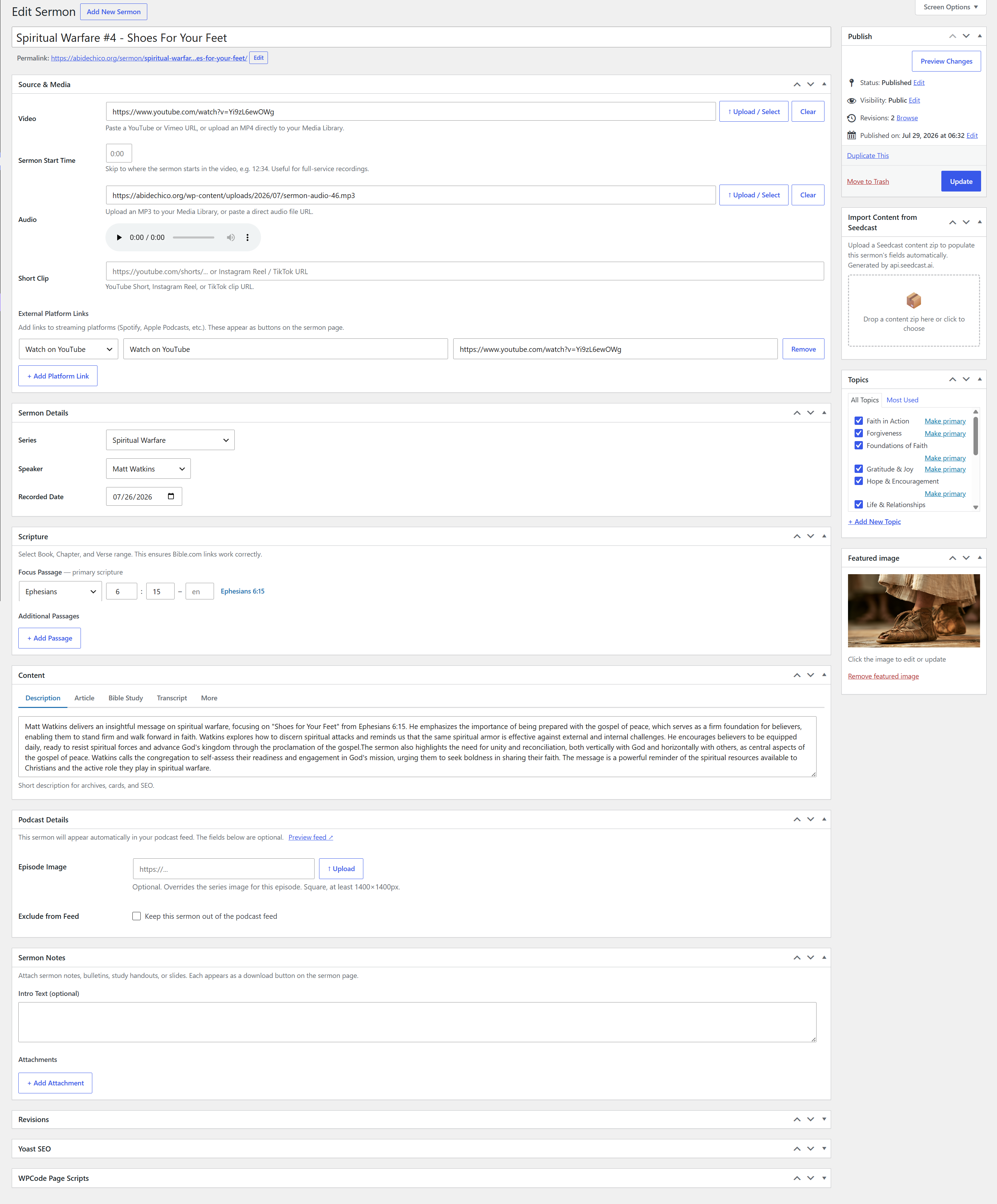
Sermon Library gives every sermon a full record: the video, the audio, a written article, a Bible study, the transcript, and the sermon notes. Each one is a tab on the sermon page, each one is downloadable as a PDF, and all of it is indexable by search engines. Someone who cannot make it on Sunday, or who is quietly working out whether to visit at all, gets the whole message rather than a play button.
Everything in the feature list below is in the free plugin. There is one paid add-on, and it is described at the end so you can tell the two apart.
See it in action
A church running Sermon Library on a live site:
- Sermon page with video, transcript, article, Bible study and scripture panel
- Sermon archive built from shortcodes, with live filtering
- Series listing
- Speaker profile
Already using another sermon plugin?
Sermon Library imports from the two most common ones, and it does the work for you rather than handing you a spreadsheet.
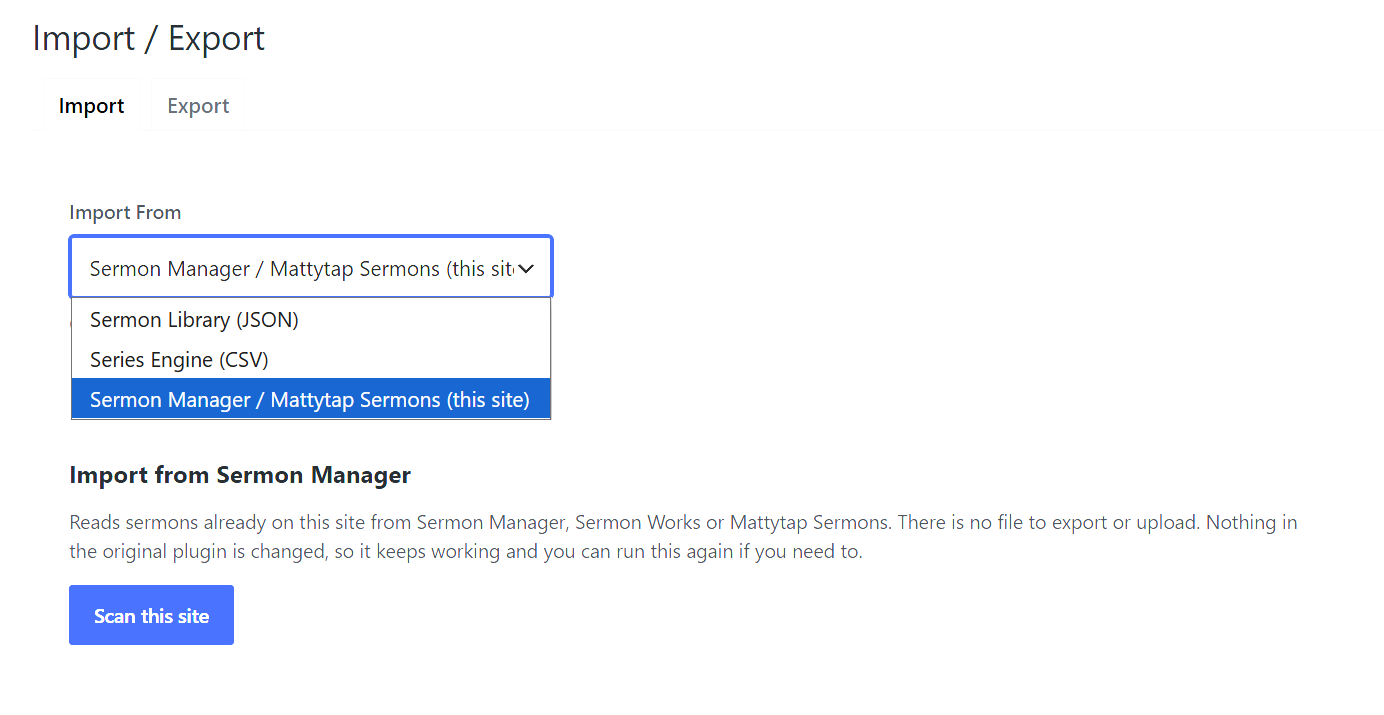
From Sermon Manager, Sermon Works or Mattytap Sermons. One click, on this site. There is no file to export and nothing to upload: the importer reads the sermons already in your database. It scans first and shows you what it found, then imports on your say so, and it never modifies the original plugin’s data, so you can compare the two before switching anything off. The old plugin does not even need to be active. If you already deactivated or deleted it, your sermons are still there and this will find them.
Your preachers and series stop being tags and become real pages. A taxonomy term can hold a name and not much else; a speaker in Sermon Library has a headshot, a bio, a title, social links and their own profile page, and a series has cover art, a description and a date range. Whatever your terms already carried comes across, and the rest is waiting to be filled in.
The importer also tidies up on the way through. Plugins that let you type a preacher’s name into a tag box tend to accumulate „Matt”, „Matt Watkins” and „Pastor Matt” as three separate people with three separate archive pages. The scan groups those together and lets you choose which to keep before anything is written.
From Series Engine. Upload your CSV export and the importer parses it, shows you every series it found, and lets you map each one to a new or existing series, or skip it. Nothing is written until you have reviewed that mapping.
Every sermon, fully documented
- Video, audio, article, Bible study, transcript and sermon notes, each per sermon
- Every written format downloads as a formatted PDF your congregation can keep
- Tabbed sermon page that keeps inactive content in the markup, so search engines index all of it
- Series with cover art, descriptions and their own archive page
- Speaker profiles with bio, headshot, contact details, social links and a full sermon listing
- Topics for browsing by theme
- Sermons fall back to their series artwork, and then to a default image you choose
- Choose which of these sections your church actually uses, and the rest stop appearing and stop being counted as missing
Put your best writing where people will find it
An article written from a sermon is worth more than a paragraph buried three tabs deep. The content shortcode lists recent articles or Bible studies anywhere on your site, as a list, a grid or a slider, and each one opens the sermon page straight to that tab.
- Articles carry their own title, which says what the piece is about rather than which Sunday it came from
- Nothing is duplicated at a second address, so your sermon page keeps every bit of its search authority
- Order by most recent, or by what people are actually reading
- Page through the whole archive, so a piece written two years ago is still reachable rather than falling off the end of a list
- Same cards, same theme, same styling as everything else on your site
Scripture that is actually structured
- Passage picker with book, chapter and verse, so references are consistent no matter who enters them
- Every passage links out to Bible.com or BibleGateway, in the translation you choose
- Filter the whole library by book of the Bible, which is how people who are studying a book actually search
- Additional passages alongside the focus passage, so a sermon that ranges across scripture says so
An audio feed you can submit anywhere
- iTunes-compatible RSS, ready for Apple, Spotify and every other listening app
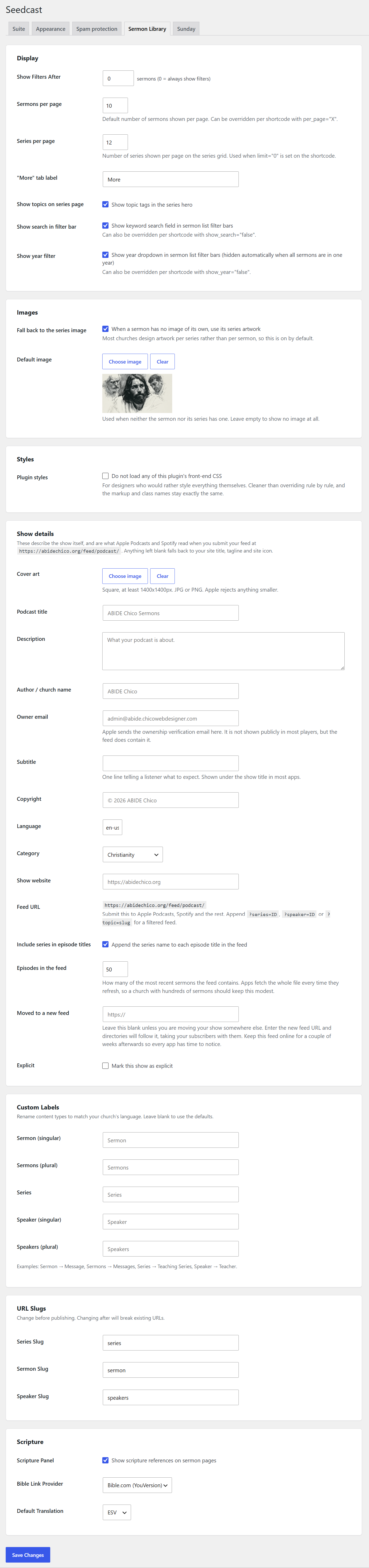
- Show settings for cover art, title, subtitle, description, author, owner email, copyright, language and category
- Filtered feeds per series, speaker or topic, so a study series can stand as its own show
- Per sermon control over audio length, file size, episode art and whether it appears at all
- A redirect field for the day you move your show somewhere else, so your subscribers follow
Your recordings stay yours
If you ever use the paid add-on below, your audio is served from Seedcast’s storage. This free plugin can copy every one of those files back into your own media library and repoint each sermon as it goes, and it does not need a key, a subscription or the add-on to be installed to do it.
That is deliberate. A way out that stops working when the thing you are leaving stops working is not a way out. Whatever happens to Seedcast, or to your subscription, or to us, a church can take its own recordings back.
Know what is still missing
A sermon library goes stale quietly. A week gets skipped, a transcript never gets pasted in, a series runs without artwork, and nobody notices until somebody goes looking for a message that turns out to be a bare title and an audio file.
The Completeness report tells you where you actually stand.
- A single library score for everything you have published, with the sermons grouped into Complete, Almost there, Needs work and Just started
- A list of what is missing most often, so you can see which one thing would move the number furthest rather than working through sermons one at a time
- A score on every row of the sermon list and in the sermon editor, showing exactly which fields that sermon is short of
- Separate figures for sermon details and written content, so you can tell which of the two is lagging
- A week by week record, which locks once the week has passed. Your library score keeps rising as you fill things in; the weekly record stays an honest account of how each week went
- Weeks with nothing posted count as zero rather than being skipped, so the record reflects the gaps as well as the work
It is scored only against the content sections you have chosen to use. Switch Bible studies off and you are not marked down for not writing them. The whole thing can be turned off in settings if you publish recordings and nothing else and would rather not see any of it.
Your church details, entered once
Your church name, address, service day, service times, phone, contact email, events page and a short word for first time visitors, stored once and shared by every Seedcast plugin on the site.
Drop them into your footer, your contact page or anywhere else with the [seedcast_church_details] shortcode or the matching Elementor widget. Change your service time in one place and every page that mentions it changes with you. Churches that meet on a Saturday, or midweek, are handled properly rather than having Sunday assumed on their behalf.
Built for the way churches actually run their sites
- Works with any theme. Fonts and colours are inherited from your theme rather than overridden
- Tested with Elementor and Divi, which is what most church sites are built on
- Every template can be overridden from your theme folder
- Turn the plugin’s CSS off entirely if you would rather style it all yourself
- Visual shortcode generator, so there is nothing to memorize
- Four appearance presets if you would rather not touch CSS
Shortcodes
[scsl_sermon_list]: paginated sermon list with a full filter bar[scsl_series_grid]: grid or slider of series[scsl_speaker_grid]: grid or slider of speakers[scsl_latest]: the most recent sermon[scsl_content]: recent articles or Bible studies, anywhere on your site, paginated if you want the whole archive reachable[scsl_topic_list]: grid of topic pills for the topics your sermons are tagged with[seedcast_church_details]: your church name, address, service times and directions link, wherever you want them
Found by search engines and AI assistants
- JSON-LD structured data for VideoObject, AudioObject, Person and BreadcrumbList
- Meta description, Open Graph and Twitter Card tags, which step aside automatically if Yoast, Rank Math, AIOSEO or SEOPress is handling them
- Real URLs and working pagination on first load; filtering only switches to AJAX once someone uses it
One paid add-on, if you want it
Everything above is free and stays free. Nothing below is required, and nothing above stops working without it.
The written formats the free plugin gives every sermon a place for, the article, the Bible study, the transcript, still have to be written by somebody. For most churches that is a volunteer with a few hours on a Monday, and in practice it usually means those tabs stay empty.
Sermon Library AI does that writing from the recording you already made. It arrives as a separate plugin, the Seedcast AI Engine, installed alongside this one. Upload the Sunday video, and the transcript, article and Bible study come back written from what was actually said. Nothing publishes on its own: content arrives staged and unsaved with a Discard button next to Update, and it lands in the same fields this plugin already provides, so nothing about your site changes shape.
It follows the same Content You Use setting as everything else here. Switch a section off and nothing is written for it.
Details and pricing: seedcast.ai
Who this is for
Churches and ministries that want their teaching to be findable, readable and shareable rather than locked inside a video player. It suits a church of forty as well as one of four thousand: there is nothing to configure before it works, and nothing you outgrow.
Zrzuty ekranu





Instalacja
- Upload the
seedcast-sermon-libraryfolder to/wp-content/plugins/ - Activate the plugin through the Plugins menu in WordPress
- Permalinks are refreshed automatically on activation
- Go to Sermon Library in the admin menu to start adding content
Moving from another plugin? Go to Sermon Library > Import / Export and choose your existing plugin from the list. Import it before you deactivate anything, so you can compare the two.
Najczęściej zadawane pytania
-
I use Sermon Manager. Can I move my sermons across?
-
Yes. Choose Sermon Manager on the Import / Export screen and click Scan. It reads the sermons already on your site, whether they came from Sermon Manager, Sermon Works or Mattytap Sermons, and shows you what it found before writing anything. Your existing plugin and its data are left exactly as they are.
The old plugin does not have to be active. If you already deactivated or deleted it, your sermons are still in the database and this will find them.
Preachers and series become full profile and series pages rather than taxonomy terms, so they gain a headshot, a bio, cover art and their own descriptions. Sermons keep their audio, video, scripture reference, date, image, notes, bulletins, view counts and publication status.
-
What happens to duplicate preachers and series?
-
The scan finds them and shows you. Any plugin that lets a name be typed freely into a tag box ends up with several spellings of the same person, each with its own archive page. Sermon Library groups the likely duplicates, suggests which record to keep, and lets you merge them before the import writes anything. You can also choose to leave them separate.
-
Can I try the import without committing to it?
-
Yes, in two ways. The scan is read only, so you can look at what would happen and stop there. And when you do import, you can bring everything in as drafts, check it, and publish when you are happy. Nothing in your old plugin is changed either way, so both plugins can run side by side while you compare.
-
I have a podcast listed on Apple. Will migrating break it?
-
Only if you skip a step, so do this one first. Your feed URL changes when you move, and directories need telling. Before deactivating your old plugin, set its podcast Redirect field to your new feed URL, which you will find under Settings in the Sermon Library section. Leave both running for a couple of weeks so every app has time to follow, then switch the old one off. Your subscribers come with you.
-
Can I import from Series Engine?
-
Yes. Export your sermons from Series Engine as CSV, then upload it on the Import / Export screen. The importer parses the file, lists every series it found, and lets you map each one to a new series, an existing one, or skip it. Nothing is written until you have reviewed that mapping.
-
Can visitors download the sermon transcript?
-
Yes. Transcripts, articles, Bible studies and sermon notes each get a PDF download button on the sermon page. Nothing extra is required.
-
Can I submit the audio feed to Apple and Spotify, and can one series have its own?
-
Yes to both. The RSS feed is iTunes compatible, and the show settings cover everything Apple checks for, including the owner email it uses to verify ownership and the artwork requirements. Your feed URL is on the Sermon Library settings screen.
For a single series, speaker or topic, append
?series=ID,?speaker=IDor?topic=slugto that URL. The result is a feed containing only those sermons, which can be submitted separately. -
Can people search sermons by book of the Bible?
-
Yes. Scripture is entered through a structured picker rather than a free text field, so the whole library can be filtered by book, and every passage links out to Bible.com or BibleGateway.
-
Does it work with Elementor and Divi?
-
Yes. All five shortcodes render inside page builders, and the styles load in the Elementor editor as well as on the front end.
-
What permalink structure is required?
-
Sermon Library requires a non-plain permalink structure. Go to Settings > Permalinks and choose „Post name” or any other option besides „Plain.”
-
Can I override the templates?
-
Yes. Copy any template from
wp-content/plugins/seedcast-sermon-library/templates/towp-content/themes/your-theme/seedcast-sermon-library/and edit freely. -
Does this affect my existing content?
-
No. Sermon Library adds its own post types and taxonomies. Your posts, pages and any other plugin’s content are untouched.
-
What happens if I deactivate the plugin?
-
Your sermons, series and speakers stay in the database. Deactivating hides them from the front end; it does not delete anything. The weekly completeness record is kept as well, since it cannot be rebuilt after the fact, so reactivating picks up where you left off rather than starting over.
-
What PHP version is required?
-
PHP 7.4 or later. The plugin is tested against 7.4 on every release.
-
Are there external service calls?
-
Nothing is contacted while a visitor reads your site, and nothing is sent anywhere in the background. Completeness scores, the weekly record and your church details are held in your own database and are never sent anywhere. Three things reach outside this site, all of them only when something is done deliberately.
Scripture links point to Bible.com (YouVersion) or BibleGateway. These are ordinary links in the page. Nothing is sent unless a visitor clicks one, and then only by their own browser.
Audio reclaim downloads files from Seedcast’s public media storage (media.seedcast.ai) into your media library. It runs only when an administrator starts it from the Import / Export screen, and only for sermons whose audio is already hosted there. It requests the file and nothing else: no account, no key, and no information about your site is sent. Seedcast’s terms are at seedcast.ai/terms and its privacy policy at seedcast.ai/privacy.
Spam checking is part of the shared Seedcast library this plugin bundles, and Sermon Library does not switch it on: there are no public forms here, so it never runs. It is described because the code is present. Where a Seedcast plugin does use it, and only if an administrator has entered keys for one, a submitted form sends that form’s challenge token and the submitting visitor’s IP address to Google reCAPTCHA, hCaptcha or Cloudflare Turnstile so the answer can be checked. No keys are set by default, and with none set nothing is contacted.
-
How is the completeness score worked out?
-
Every sermon is scored on the details that make its page usable, speaker, series, focus passage, a recording and an image, and on the written sections you have said you use. Your library score is the average across every sermon, not a count of finished ones, so it moves whenever you fill anything in.
The exact fields being counted are listed at the bottom of the Completeness report, so the page always documents the rules it is applying rather than sending you elsewhere to find out.
-
Why does a week show as zero when I posted the sermon later?
-
The weekly scores record whether the work happened while it was that week’s work, so they lock once the week has passed. A sermon dated back to an earlier week after that week has closed still counts toward your library score, but it does not change the record of the week itself.
Correcting a genuine mistake does work. If you mistype a date and fix it, the weeks involved are recalculated and marked as amended, because the sermon did exist at the time.
-
I only publish recordings. Can I turn the scores off?
-
Yes. Settings, Display, and untick Show completeness scores. That removes the scores from the sermon list, the sermon editor and the menu.
Weekly scores carry on being recorded quietly. They cannot be worked out after the fact, so if you switch the display back on a year from now the record is still there rather than starting from nothing. None of it leaves your site.
-
Does it work with Yoast SEO or RankMath?
-
Yes. When a dedicated SEO plugin is active, Sermon Library steps aside and lets it handle meta descriptions, Open Graph and Twitter Card tags. Structured data for sermons is still added, because SEO plugins do not know what a sermon is.
Recenzje
Wtyczka nie ma jeszcze żadnej recenzji.
Kontrybutorzy i deweloperzy
„Sermon Library” jest oprogramowaniem open source. Poniższe osoby miały wkład w rozwój wtyczki.
Zaangażowani
Przetłumacz wtyczkę “Sermon Library” na swój język.
Interesuje cię rozwój wtyczki?
Przeglądaj kod, sprawdź repozytorium SVN lub czytaj dziennik rozwoju przez RSS.
Rejestr zmian
2.50.2
- Shortened the upgrade notice, which exceeded the length WordPress.org allows.
2.50.1
- Plugin Check cleanup: the completeness queries now use WordPress’s identifier placeholder for the table name, and the report screen reads its query arguments through a single sanitised helper.
- Minimum WordPress version is now 6.2, which is where the identifier placeholder was added.
2.50.0
- The Sermons tab on the Completeness report now shows the service week each sermon counted toward, and whether that week is a closed record, still open, or from before you started measuring.
- Made clear that the score on each row is where the sermon stands today, which for a closed week is not the same as the score that week was recorded at.
2.49.2
- Documentation only. The readme now describes the Completeness report and the shared church details, with answers on how the score is worked out, why a locked week does not change, and how to switch the scores off.
2.49.1
- Fixed completeness scores not updating after changing which content sections you use. The scores are cached, and changing the setting did not clear the cache, so the report kept showing figures from before the change for up to fifteen minutes.
- Scores now also refresh when a sermon is added, deleted, trashed or restored.
2.49.0
- The comprehensive score now appears alongside the library score above the sermon list, when you have some content sections switched off.
2.48.1
- Fixed two settings checkboxes that could not be switched off. Completeness scores and Tidy transcripts would report as saved and then come back switched on.
2.48.0
- Added the library score above the sermon list, with the group counts, linking through to the Completeness report.
- Added a setting to turn completeness scores off. If you only publish recordings, the scores and labels can be hidden from the sermon list, the sermon editor and the menu.
- Weekly scores continue to be recorded even with the display turned off, so nothing is lost if you switch it back on later.
2.47.0
- Sermons are now grouped into Complete, Almost there, Needs work and Just started, on the report, in the sermon list and in the sermon editor.
- The Completeness report shows how your library is spread across those groups, so progress is visible rather than being one large number.
- Each group can be clicked to see just those sermons.
2.46.0
- Clearer Completeness report. The library score is an average across all your sermons and excludes nothing, which the page now says plainly.
- Replaced the completed count with how many sermons need work, which links straight to them.
- Moved the undated sermon warning next to the weekly scores, which are the only scores it affects.
2.45.0
- The completeness score on the sermon list and in the sermon editor now links straight to the Completeness report.
- The sermon editor shows how long after the service that sermon was finished.
- The Completeness report shows how long your sermons typically take to finish, counted only from sermons posted since you started using the report.
2.44.0
- The sermon list now shows a completeness score at the top of the Content column, with the sermon details that are missing listed underneath.
- Added a Completeness box to the sermon editor showing the score and exactly what is present and what is not.
- The More tab no longer counts against completeness. Nothing can generate it and most sermons never have one, so it was holding every sermon below 100.
- Fixed the sermon list stylesheet, which was never loaded on that screen, leaving the Content column unstyled.
2.43.0
- Completeness now shows which sermons are missing what. A new tab lists every sermon worst first, filterable by needs work, complete, or no date.
- Added a summary of how many sermons are missing each field, so you can see at a glance which one thing would move your score the most.
- The completed count on the overview now links straight to the sermons that need attention.
- Fixed the progress bars, which were hard to read against a white background.
2.42.0
- Completeness now respects the content sections you have chosen to use, so you are only scored on what you actually want.
- Added a Comprehensive score view, shown only when you have some content switched off, so you can see what a fuller library would look like.
- Generate Sermon is now visible on every site and explains what sermon generation does.
- Fixed the plugin row link, which used an old product name and pointed at the wrong page.
2.41.0
- New: Completeness report. A single score for your sermon library, plus a week by week record of how each week actually went. Find it under Sermon Library, Completeness.
- Weekly scores lock once the week has passed, so the record reflects whether the work happened that week. Your library score keeps rising as you fill things in.
- Sermons without a recorded date are not counted toward any week, and are now flagged on the sermon list so they are easy to find.
- Scores separate sermon details from written content, so you can see which is lagging.
2.40.0
- New: Church details, shared across every Seedcast plugin. Set your church name, address, service day, service times, phone, contact email, events page and a note to visitors once under Settings, Seedcast, Church.
- New: [seedcast_church_details] shortcode and a matching Elementor widget, so the same details can appear in your footer, on your contact page, or anywhere else without being retyped.
- Churches meeting on a day other than Sunday are now handled properly wherever the service day is referenced.
- Fixed a fatal error in the shared library that affected sites running a Seedcast plugin which collects form submissions.
2.39.0
Pagination for the content shortcode
[scsl_content]can now page through the whole archive rather than showing only the newest few. Older articles and Bible studies stop being unreachable once enough newer ones exist.- The shortcode generator gained a Pagination option under Content, which appears for the list and grid layouts and hides itself for the slider, where pages have no meaning. With it on, the count below becomes how many appear per page.
- Series grid pagination now uses the shared page control the rest of the suite uses, so it collapses long runs instead of printing one link for every page, and matches the styling of everything around it.
- The shortcode generator now opens on Latest Sermon, which needs nothing configured, rather than on a display that does.
2.38.4
Sermon card visual polish
- The View Sermon call to action now uses the site’s shared button style rather than a card-specific pill, so it matches the rest of the site’s design.
- Card visual weight (background, radius, hover lift) now uses the same design tokens as other cards in the Seedcast family so it feels of a piece with the rest of the site.
- Sermon poster is larger and has rounded corners.
2.38.3
More context on the sermon card
- The sermon card on Living Bulletin service pages now includes a metadata column: speaker, series (linked to the series page), and article (linked to the sermon page’s Article tab), plus direct links into the Bible Study and Transcript tabs when those exist on the sermon.
- Each row appears only when the sermon has that content, so a bare sermon collapses cleanly.
- Cards fill the section width rather than being capped, so a single sermon reads as substantive content rather than a small tile.
2.38.2
Sermon card polish on Living Bulletin service pages
- Sermon poster art now shows in full instead of being cropped. Cards use a soft matte around the poster so different image proportions (portrait posters, landscape banners, square photos) all render cleanly.
- Cards flow in a responsive grid rather than stretching full width. One sermon looks like a card, several sermons flow into columns based on available space.
2.38.1
Bug fix
- Fixed a fatal error on plugin activation caused by the autoloader not knowing where to find the
LivingBulletinBridgeclass. This class ships inincludes/Frontend/class-livingbulletinbridge.phpbut the autoloader was deriving a different filename from its name, so the class was never loaded.
2.38.0
Living Bulletin integration and suite plumbing tidy up
- Sermons for the day now appear on the Living Bulletin service page for the same date. Cards show the sermon’s featured image, title, speaker, and short excerpt, with a link straight to the sermon. Multiple sermons on one day stack. No configuration is needed – the cards appear automatically whenever the dates line up. If Living Bulletin is not installed, nothing changes.
- Upgraded the bundled Seedcast Core library to 1.9.0. The suite grid is now built from what each installed plugin registers about itself at runtime, so adding a new suite plugin no longer needs an update to every other plugin’s copy of the library.
- Sermon Library registers its own suite grid card metadata (name, tagline, icon, admin URL) rather than falling back to core’s built-in catalog.
2.36.0
Put your writing where people will find it
- New
[scsl_content]shortcode lists recent articles or Bible studies anywhere on your site, as a list, a grid or a slider. Each one opens the sermon page straight to that tab, so nothing is published twice and your sermon page keeps its search authority. - Articles carry their own title in listings and as the heading on the sermon page, so a piece is named for what it is about rather than which Sunday it came from.
- New
[scsl_topic_list]display in the shortcode generator, for the topics your sermons are tagged with. - Order any listing by most recent or by what people are actually reading.
Choose what your church publishes
- New setting for which content sections you use. Anything switched off stops appearing on your sermon pages and stops being counted as missing.
- Scripture references are now a section of their own, so a sermon can list every passage it covers, or just the one it is on.
- The name you give the More tab is now kept in revision history along with the rest of your content.
Fixes
- The book filter now lists only books a sermon is actually about, taken from its focus passage, and finds them. Previously it listed every book mentioned in passing and returned nothing useful.
- Filtering series by topic now works. It matches series through the sermons in them, which is where a series gets its subject from.
- Grids now honour the number of columns you asked for. Series and speaker grids had been collapsing to a single column.
- View counting no longer stops working on cached sites. The counter relied on a security token baked into the page, which expires long before a cached page does, so views were being silently discarded.
- Speakers can be ordered by how many sermons they have preached, which usually puts your pastor first without arranging anything by hand, and individual speakers can be left out of a listing.
- Series per page can now be set on the shortcode rather than only in settings.
- The shortcode generator no longer carries a setting from one display type to the next, and no longer writes out values that are already the default.
2.20.0
- Sermon content now appears on your home page or anywhere else through a single shortcode, rather than only on the sermon page.
- Visual shortcode generator gained Content and Topics displays alongside sermons, series and speakers.
2.14.0
- Article titles are derived from the article itself, so the field fills in as soon as the content arrives.
- Scripture references found in a sermon are stored alongside the focus passage, with duplicates and the focus passage itself filtered out.
2.10.0
- New setting for which content sections your church uses, so the sermon page shows what you publish and nothing else.
- The sermon list now shows what each sermon has and what is missing, so an archive can be filled in without opening every one.
2.6.0
- Sermon content is now kept in revision history. The summary, article, study guide, resources and transcript can be compared and restored from the Revisions screen like any other content, whether they were written by hand or generated. Previously none of these fields had any history at all.
2.5.1
- The podcast feature is now called the Sermon Audio Feed throughout the admin. Only the wording changed: your feed address, its contents and every setting are exactly as they were.
2.5.0
- Added a way to copy sermon audio hosted by Seedcast into your own media library, so your recordings are always yours to take back. Optional, and nothing needs doing if you are happy as you are.
2.4.0
- Added a Podcast screen showing everything in your feed, everything that is not, and why. Sermons can be added to or removed from the feed from one place instead of one sermon at a time.
- Fixed the podcast include option on the Generate Sermon screen, which had no effect either way.
2.3.3
- Fixed a notice logged on every request under WordPress 6.7 and later, caused by the plugin registering itself with the shared library before translations were available.
2.3.1
- Fixed a PHP warning on series pages caused by an undefined variable in the filter bar.
- Added a Generate Sermon screen under Sermon Library, explaining how the Seedcast AI Engine turns a recording into a summary, outline, study notes, study guide, article, scripture list, FAQs and a clean transcript.
- Moved the mapping between generated content and sermon fields into one place, so the content zip importer and the Seedcast AI Engine fill in a sermon identically.
2.3.0
Importing
- Added a one click importer for Sermon Manager, Sermon Works and Mattytap Sermons. It reads the sermons already on the site rather than asking for a file, and changes nothing in the original plugin. The old plugin does not need to be active, so a site that already removed it can still recover its sermons.
- The importer scans first and reports what it found, including duplicate preachers and series, which you can merge before anything is written.
- Choose whether to import everything as drafts or to match the publish state of the original.
- Preachers and series become full speaker and series pages, carrying across whatever description the original term had.
- Notes and bulletins come across as downloadable files on the sermon, labelled from the attachment title.
- Scripture references that cannot be read as a book, chapter and verse are listed for you rather than guessed at, and are imported as written.
- Re-running the import updates what came across the first time instead of duplicating it.
- Fixed: the Series Engine importer was missing its upload step entirely, so there was no way to choose a CSV.
- Fixed: the Series Engine series mapping screen showed internal label names such as „slImportI18n.importAs” instead of the labels themselves, and series titles containing an ampersand displayed as „&”.
Audio feed
- Added show level settings: cover art, title, subtitle, description, author, owner email, copyright, language, category, show website, and an explicit flag.
- Fixed: the feed hardcoded its language, category and explicit flag, and carried no owner email at all. Apple requires one to verify ownership, so the feed could not be submitted before this.
- Every field falls back to your site title, tagline, admin email and site icon, so a feed you never touch is still valid.
- Cover art is stored as a media library reference rather than a URL, so the full size image is used in the feed. Apple rejects artwork below 1400×1400.
- Added a limit on how many episodes the feed contains, defaulting to 50. It was previously fixed at 200, which is a large file for apps to fetch on every refresh.
- Added a „moved to a new feed” field. If you ever relocate your show, this is what tells directories to follow, so your subscribers go with you.
Images
- A sermon with no image of its own now falls back to its series artwork, then to a site-wide default image you can set. Applies everywhere: sermon pages, archives, shortcodes, structured data and the feed.
- Added an option to load none of the plugin’s front-end CSS, for designers who would rather style everything from scratch. The markup and class names are unchanged.
Compliance
- File reads and deletes in the content importer now go through WP_Filesystem, so they work on hosts where WordPress writes over FTP or SSH rather than as the web user.
- The bundled shared library now adopts the plugin’s own text domain, so its strings are translated alongside the rest of the plugin.
Settings and admin
- Settings moved to Settings > Seedcast, in one permanent place alongside any other Seedcast plugin you run. The Settings link under the Sermon Library menu goes straight there.
- Theme choice is now shared across Seedcast plugins, so they match without configuring each one. Your existing choice is carried over on update.
- The Import Content box on the sermon editor moved to the sidebar, under Publish.
- Removed the Date Range and Topics columns from the Series list. Neither is an attribute of a series and both were always empty.
- Sermons now appear first in the menu, and Topics sits with the content screens rather than after the shortcode tool.
- Fixed: deleting a topic emptied the page instead of returning to the list. The topic was deleted, but the redirect could not run because the page had already started rendering.
- Fixed: the Series and Speaker pickers on a sermon listed only published records, so a sermon correctly linked to a draft appeared to have no series or speaker at all.
Appearance
- Front end output now inherits fonts and text colours from your theme instead of setting its own. Sermon pages, series pages and the shortcodes will look more like the rest of your site.
- Shared components (buttons, lists, filters, pagination, breadcrumbs, the audio player, video embeds) now come from a shared library rather than being duplicated, so they behave consistently.
- Removed the underline and fixed heading sizes that were being applied to section titles.
- Fixed: series artwork was forced into a square container, leaving dead space beneath landscape images.
- Fixed: the share divider on a sermon page drew even when there were no platform links above it.
- The X share button is now labelled „Share on X”.
Fixes
- Fixed: speaker pages referenced a variable that was never defined, producing a PHP warning on every view.
- Fixed: speaker pages ran one database query per sermon to build the series list, then one per series after that. Both are now a single query, which makes a large difference for speakers with a long history.
- Fixed: PDF download button labels were escaped twice.
- Fixed: share and Bible passage links used urlencode(), which encodes spaces as plus signs. Now rawurlencode().
- Fixed: the plugin declared PHP 7.4 as its minimum but used a PHP 8.0 function. Verified clean against 7.4.
- Fixed: the breadcrumb shown on the page and the breadcrumb sent to search engines were built separately and could disagree. Both now come from one source.
- Video embeds use YouTube’s privacy mode and Vimeo’s do-not-track flag everywhere, not just in some places.
Accessibility
- Settings sections are now real tabs with proper roles and keyboard support.
- The copy link button announces itself to screen readers instead of only changing its label.
- The theme picker shows a visible focus indicator for keyboard users.
1.7.0
- Changed: Custom post type slugs renamed from sl_ to scsl_ prefix for uniqueness
- Added: Automatic database migration runs on activation and update
- Added: JSON round-trip importer for migrating between sites
- Added: Sermon archive template at /sermon/
- Fixed: Scripture panel variable scope
- Fixed: Series hero image aspect ratio
1.5.0
- Added: Speaker grid shortcode [scsl_speaker_grid] with slider support
- Added: Speaker archive page at /speakers/
- Added: Separate headshot field for episode card thumbnail vs featured image for profile/card
- Added: Drag-to-reorder speakers in admin (same as series)
- Added: Automatic Yoast SEO / RankMath / AIOSEO configuration on first activation
- Added: Meta description, Open Graph, and Twitter Card tags when no SEO plugin installed
- Added: Export to JSON (Import / Export page)
- Added: Series Grid slider mode (slider=”true” attribute)
- Added: Series per page setting
- Added: Automatic permalink flush on plugin update, so no manual Permalinks save is needed
- Improved: Mobile layout across all shortcodes and templates
- Improved: Elementor editor CSS loading for all shortcodes
- Fixed: Series card click navigation
- Fixed: Stale JS cache causing click issues
- Removed: AI Integration settings (reserved for Pro)
- Removed: Raw transcript field (reserved for Pro)
1.4.0
- Added: Warm theme
- Added: Series Engine CSV importer with flexible series mapping
- Added: Scripture passage picker (Book, Chapter, Verse)
- Added: External platform links per sermon (Spotify, Apple Podcasts, YouTube, etc.)
- Added: Social share buttons (Facebook, X, LinkedIn, Copy Link)
- Added: Shortcode Generator admin page
- Added: SEO-friendly pagination
- Added: Drag-to-reorder series
- Added: Admin filters for sermon list (Series, Speaker, Topic)
- Added: Topics manager page
- Added: Podcast RSS feed
1.0.0
- Initial release